
Every morning across Ilorin, Kwara State, a quiet, repetitive ritual takes place surrounding practical data skills.
In a bustling retail shop on Agbo Oba Road, a sales clerk opens a thick, paper ledger to write down the date, items sold, and cash received. In a private community clinic nearby, a nurse systematically fills a cardboard folder with a patient’s vital signs before sliding it into an overflowing metal cabinet. At a primary school, a class teacher marks attendance in a blue register, later copying termly exam scores into personal exercise books. Meanwhile, at a local non-governmental organisation (NGO) off Ibrahim Taiwo Road, staff pass around paper sign-in sheets to collect the names, phone numbers, and signatures of community beneficiaries.
This is the ritual of record-keeping. Across Nigeria, offices and small businesses are not short of records. Every day, they compile mountains of attendance sheets, sales logs, expense trackers, student marks, and patient details.
Yet, beneath this massive paper and digital trail lies a silent, structural failure: almost none of these records are ever used to make decisions. The shop owner cannot tell which of their products yields the highest net profit margin or which days of the week are slow. The school principal cannot identify which pupils are on the verge of dropping out based on early attendance patterns. The clinic continues to operate with long waiting times because patient flow data is never analysed. The NGO struggles to prove its impact to international donors because its beneficiary registers are buried in cardboard boxes.
Nigeria, it turns out, does not only have a data collection problem. It has a data usage problem.
The Credential Paradox and the Skills-First Shift
This disconnect represents an expensive bottleneck for the Nigerian economy, but it also reveals an extraordinary opportunity for the country’s youthful population.
Nigeria sits at the centre of Sub-Saharan Africa’s demographic transition. With a population of approximately 220 million people, Nigeria’s median age is just 18.1years with over 60% of the population under 25. This youth wave adds approximately 3.5million young entrants to the domestic labour force annually.
Yet, traditional paths to employment are failing. According to the National Bureau of Statistics (NBS) labour force statistics, national unemployment has historically hovered around 33.3%, with youth unemployment peaking at 42.5%. Crucially, the data reveal a “credential paradox”: individuals holding advanced secondary and tertiary qualifications recorded some of the highest unemployment rates. Those reporting A-levels as their highest qualification faced an unemployment rate of 50.7%, while Bachelor’s degree or Higher National Diploma (HND) holders stood at 40.1%.
In stark contrast, out of the 30.6 million fully employed Nigerians during this period, 8.41 million had never attended school, and 15.62 million had no tertiary education. This pattern underscores the limitations of traditional white-collar employment pathways and emphasizes the need for a transition toward practical, skills-based training.
As a result, the domestic recruitment market is transitioning toward a “skills-first” model. Driven by automated applicant tracking systems and artificial intelligence, more than 50% of employers are shifting away from rigid credential checks, focusing instead on verifiable technical capabilities.
If local offices, clinics, schools, and small and medium-sized enterprises (SMEs) are sitting on mountains of unutilised files, they do not need employees with generic degrees. They need young people who can walk into their offices, open those dusty folders or messy spreadsheets, and turn those records into actionable business strategies.
What the Equations Tell Us: The Microeconomic Proof
At the microeconomic level, data analytics has become the primary driver of corporate competitiveness and operational efficiency. Empirical studies by the OECD and the World Economic Forum highlight that SMEs integrating data analytics into their operations record up to 25% higher productivity growth than non-adopting competitors.
However, technology is only as good as the human being operating it. This is not a mere assertion; it is a proven statistical reality.
In a study published in the Malete Journal of Accounting and Finance (Azeez et al., 2025), researchers surveyed 359 registered SMEs in Ilorin, Kwara State, to measure the impact of digitalised accounting information systems (AIS), automation, and employee digital competency on corporate operational efficiency.
The results are striking: employee digital competency (1 = 0.364) is the single strongest positive predictor of SME operational efficiency. Simply purchasing software packages or adopting technology platforms (beta_3 = 0.237) yields significantly lower returns if the workforce lacks the analytical competency to use these tools effectively. For SMEs to achieve tangible efficiency gains, they must prioritize upskilling programs alongside technology acquisition.
This is further supported by regional research. A quantitative study by Aremu and Egunjobi (2025) published in the Lead City Journal of the Social Sciences (LCJSS), which used Taro Yamane’s sample size formula to survey youth, revealed a strong positive correlation and a statistically significant regression relationship between digital skills acquisition and youth unemployment reduction: R = 0.554 (p < 0.001)
The microeconomic proof is clear: when young people are equipped with advanced analytical competencies, their personal value to the local labour market and the operational performance of the businesses they support increase in lockstep.
The Spark at Agbo Oba: Cultivating Practical Data Skills in Ilorin
To understand how this gap can be bridged on the ground, one does not need to look further than Agbo Oba in Ilorin, Kwara State. Here, the Craft Innovation Hub (CIH) recently launched a localized response to this national data bottleneck.
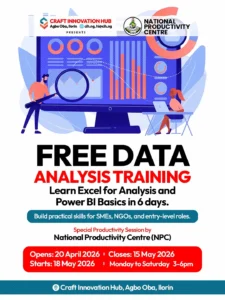
Under the leadership Abdulrasaq Ahmed Abiodun, the hub organized an intensive, project-based Data Analytics Pilot Cohort in November 2025. This cohort was designed to test a simple thesis: can local graduates learn to solve real-world record problems in their communities by mastering practical data skills in Ilorin?
The pilot program generated substantial local interest:
- The Talent Pool: 110 applied for the training.
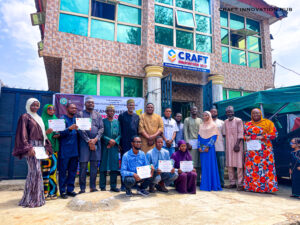
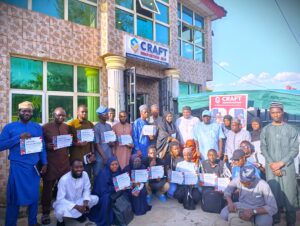
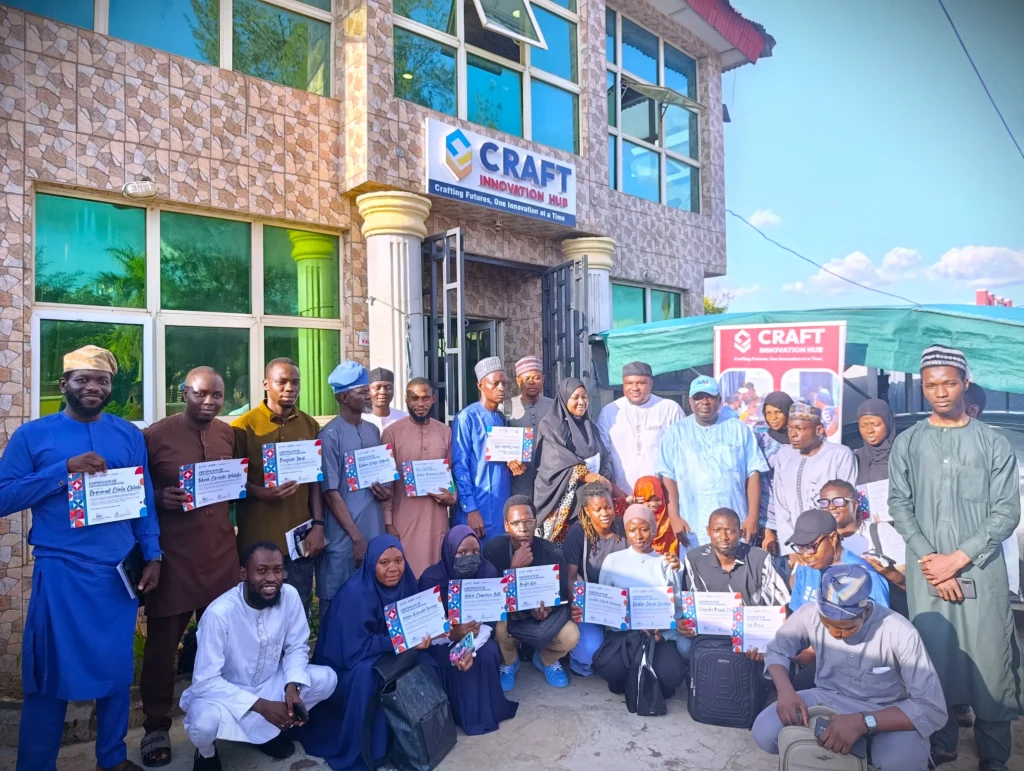
- The Certified Cohort: A highly motivated group of 27 trainees was selected and successfully certified through the intensive pilot.
- The Analytical Toolset: Trainees mastered Microsoft Excel (advanced pivot tables, logical functions, data cleaning).
- The Focus of Study: Rather than practicing on abstract global datasets, trainees worked on cleaning and interpreting simulated local health, fashion, and retail transaction.
The training was not presented as a magic bullet to turn participants into expert data scientists in a single week. Instead, it was designed as a high-impact entry point into a lifelong learning journey. Trainees learned how messy, real-world records, full of duplicates, typos, and missing fields, could be systematically cleansed and turned into visual, executive dashboards.
“We see organisations every day that are drowning in paper but starving for information,” says Abdulrasaq Ahmed Abiodun. “Our goal is not just to teach young people how to click buttons in a software application. We want them to develop the analytical mindset required to look at a local retail register and say, ‘This is where your business is losing money, and this is how you can fix it.’“
Localising the Power of Data in Kwara State
For Kwara State, which is rapidly positioning itself as an emerging digital frontier in North Central Nigeria, this skills transition is vital. Kwara State possesses a robust economy with a GDP estimated at ~₦3.2 trillion (approximately $4.1 billion) and a managed annual growth rate of 4.2%. While agriculture remains the backbone of the state’s economy, contributing 40% of its GDP, the state has prioritized the expansion of its digital economy.
This vision has been catalyzed by deliberate public policies. A key turning point occurred when the Kwara State Government slashed Right of Way (ROW) fees for fiber optics from ₦5,500 per kilometer to a nominal fee of ₦1 per kilometer. This bold move sent a clear signal to private investors and attracted the global telecommunications giant IHS Nigeria. In partnership with the state government, Co-Creation Hub (CcHub), and Future Africa, IHS co-built the Ilorin Innovation Hub (IIH).
Developing practical data skills in Ilorin is the catalyst needed to transform local sectors:
- Agribusiness: By tracking input costs, weather-dependent yields, and market price fluctuations, local cooperatives can decide the optimal week to sell harvests rather than falling victim to middlemen.
- Fashion and Retail: Rather than guessing fabric trends, designers can track customer preferences, seasonal order frequencies, and inventory turnaround times to reduce fabric waste.
- Private Schools: Administrators can correlate attendance records with termly grade averages, allowing teachers to intervene before a student fails.
- Logistics: Small dispatch companies can map delivery times, peak hours, and customer complaints to optimise delivery routes, directly lowering fuel costs in an era of subsidy removal.
From Records to Results
To move from merely collecting ledgers to driving results, Nigerian organisations must realise that data analysis is not a purely technical exercise. It is an operational culture that requires several key ingredients:
- Accurate Data Entry: If the initial record-keeping is careless, the resulting analysis will be flawed.
- Data Cleaning: Real-world records are full of duplicate names, empty rows, and typos. Knowing how to tidy data is 80% of the battle.
- Basic Numeracy & Ethical Handling: Professionals must handle records honestly and protect customer privacy.
- Visualisation & Communication: An Excel sheet with thousands of rows is useless to a busy manager. It must be translated into a clean, simple chart.
- Willingness to Act: Business owners and government directors must be willing to change their minds when the data contradicts their personal opinions.
One Week Is Only the Beginning
While the graduates of the Craft Innovation Hub training left with technical confidence, both the hub and the academic community emphasize that data analysis is a muscle that requires continuous exercise.
Moving from basic data analysis to advanced specializations, such as Machine Learning (ML) engineering, requires sustained commitment. Yet, the wage premiums make this journey highly lucrative for Nigerian youth.
NIGERIAN DATA PROFESSIONALS’ WAGE PREMIUM
| Junior Data Analyst | Senior Machine Learning Engineer |
| ₦150k – ₦280k/month (Local) | ₦900k – ₦1.5m+/month (Local) |
| $800 – $1,500/month (Remote) | $3,000 – $9,000+/month (Remote) |
To bridge this professional gap, trainees need access to three elements: continuous practice on real datasets, local or remote mentorship, and a business community willing to open its doors. Local retail brands, private clinics, schools, and agribusinesses must move past their initial hesitation and allow these trained youths to intern, volunteer, and work with their anonymised transactional records.“I used to think data analysis was only for computer scientists and mathematicians,” noted one of the participants at the Agbo Oba training. “But during this week, I saw how a simple record of a shop’s daily sales, when cleaned and put into a simple chart, can immediately show which products are wasting the owner’s capital. It has completely changed how I look at business.”
Turning Piles of Paper into Roadmaps for Growth
The future of Nigeria’s digital economy, projected by the independent research firm Public First to reach $120 billion by 2035, with broader AI adoption capable of adding $22 billion to the national GDP, will not belong to the organisations that compile the tallest stacks of paper. It will belong to those who can read between the lines of those records to solve real-world problems.
As the certified trainees of the Craft Innovation Hub return to their local communities, they carry more than just certificates. They carry the tools to transform neglected ledgers into active business insights.
By scaling these localized, public-private innovations, Kwara State is demonstrating how secondary Nigerian cities can de-risk technology, drive business efficiency, and transform their demographic wave into a digital powerhouse.
Sustainable Development Goals (SDG) Alignment
- SDG 4 (Quality Education): Providing youth with practical, market-aligned cognitive and analytical capabilities.
- SDG 8 (Decent Work and Economic Growth): Reducing youth underemployment by bridging the structural educational-market skills mismatch.
- SDG 9 (Industry, Innovation and Infrastructure): Decentralizing technical competence away from national metropolitan centers into Kwara State.
- SDG 10 (Reduced Inequalities): Empowering young people in non-metropolitan regions to access remote and high-yield work opportunities.
- SDG 17 (Partnerships for the Goals): Connecting state ministries, private infrastructure partners (IHS), and local educational hubs (CIH).